The Ledger Level 5: Investing & index funds
Don't look for the needle, buy the haystack. Index funds for my granddaughter
In 1995 Nana put $10,000 into an index fund and mostly left it alone. Here is what an index fund is, why fees matter more than you think, and what the coffee can missed.

Told by Nana
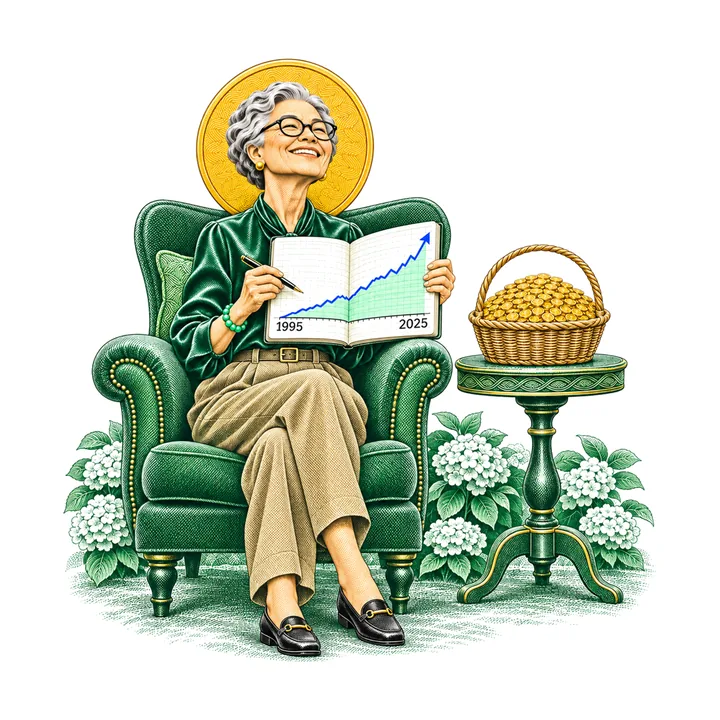
Lil asked me what my notebook with the long line in it was. I told her it is the story of $10,000 I put into an index fund in 1995 and then tried very hard to ignore.
What is an index fund?
Imagine you want to own a piece of every bakery in town, because you cannot tell which one will become famous. You could try to guess the winner. Or you could buy a tiny slice of all of them.
An index fund is the second option. It buys every company in a list, an index, such as the 500 large US companies in the S&P 500. When the whole market grows, you grow with it. You never get the single big winner, and you never hold only the single big loser.
That is what I mean by buying the haystack instead of looking for the needle.
What compounding does with time
Here is the example I show in the notebook. Say $10,000 grows by 7 % a year on average, and every year the growth is left in to grow again:
| After | Value |
|---|---|
| 10 years | $19,672 |
| 20 years | $38,697 |
| 30 years | $76,123 |
Seven percent is an illustration, not a promise. Real markets jump around. Some years fall by a third. The line in my notebook is anything but straight.
Gramps kept his $10,000 in the coffee can. Thirty years later it is still $10,000, and it buys a lot less than it used to, because of inflation.
The fee nobody looks at
Every fund charges a yearly fee called the expense ratio. It looks tiny. It is not.
Same $10,000, same 7 % before fees, 30 years:
- With a 0.03 % fee you end up with about $75,500.
- With a 1 % fee you end up with about $57,400.
That one percent cost about $18,000. Broad index funds tend to have low fees because nobody is paid to pick stocks.
What I tell Lil
- Start early. Time does more of the work than money does.
- Own a lot of companies, not one.
- Look at the fee before you look at last year's return.
- Do not panic when the line goes down. It will go down.
This is how one retired accountant did it, not advice for your situation. If you are deciding where to put real money, talk to a fee-only adviser and read the fund's documents first.
The Coins is education and entertainment, not financial, tax or investment advice. The family is fictional. Numbers are examples; past returns do not guarantee future results.